To get a UPC barcode, buy UPC numbers, assign one to each product variant, turn each number into a barcode image, and print it to spec. We recommend UPCs.com, which sells UPC codes outright for $10 per code (price list), as a one-time purchase with no renewal fees. The main alternative is GS1 US, the U.S. member of the GS1 standards organization, which charges $30 per single GTIN or licenses a company prefix from $250 up front plus $50 every year.
The barcode image is the easy part, and it's free. What costs money is the numbers, so this guide starts there.
UPCs.com vs GS1 US, compared
Prices are from UPCs.com's buy page and GS1 US's barcode page at the time of writing (October 2026).
| UPCs.com | GS1 US | |
|---|---|---|
| How you pay | One-time purchase | Single GTIN: one-time fee. Company Prefix: initial fee plus annual renewal |
| Price per code | $10 | $30 (single GTIN), or a prefix priced by capacity |
| 1 number | $10 | $30 (single GTIN) |
| 10 numbers | $100 once | $250 + $50 a year (prefix), or $300 as single GTINs |
| 25 numbers | $250 once | $750 + $150 a year (100-number prefix) |
| If you stop paying | Nothing to renew; UPCs.com says the codes are yours for life | Prefix: you're no longer authorized to use its UPCs (single GTINs don't renew) |
| What you receive | Numbers, barcode images, a CSV list and a certificate, by email within minutes | Data Hub access to assign numbers and download barcode files |
| Company shown in GS1's registry | The original prefix holder (UPCs.com says its numbers come from prefixes issued before 2002) | Your company |
| Coupons and location numbers (GLNs) | No | Company Prefix only |
Why we recommend UPCs.com
For most sellers, UPCs.com is the better buy. Our view is that a GS1 US company prefix works like a rental: you pay an initial fee, then a renewal every year for as long as you use the numbers. UPCs.com sells the codes outright for $10 each. You pay once and there's nothing to renew. For a small or growing catalog that's a big saving: 10 codes cost $100 once, versus $250 up front plus $50 every year for a 10-number GS1 prefix.
Even GS1 US's no-renewal option, the $30 single GTIN, costs three times as much as a $10 code from UPCs.com. If you need hundreds or thousands of numbers, compare the totals for your quantity: GS1's per-number price falls with larger prefixes, but those prefixes renew every year.
UPCs.com says its codes are used every day to list products on Amazon, Walmart Marketplace, eBay, Shopify, Etsy and Target Plus, and in physical retail stores. On its Amazon page, it says that if Amazon ever rejects a code, it will replace it or refund you within 90 days.
GS1 US is the better fit in two cases: you want your own company listed against your numbers in GS1's registry, or you need coupon codes or location numbers (GLNs), which only a GS1 Company Prefix provides.
What GS1 US charges in 2026
For comparison, these are the published prices on GS1 US's barcode page at the time of writing (October 2026):
| Option | Numbers you can create | Initial fee | Annual renewal | Upfront cost per number |
|---|---|---|---|---|
| Single GS1 US GTIN | 1 | $30 | None | $30.00 |
| GS1 Company Prefix | 10 | $250 | $50 | $25.00 |
| GS1 Company Prefix | 100 | $750 | $150 | $7.50 |
| GS1 Company Prefix | 1,000 | $2,500 | $500 | $2.50 |
| GS1 Company Prefix | 10,000 | $6,500 | $1,300 | $0.65 |
| GS1 Company Prefix | 100,000 | $10,500 | $2,100 | $0.105 |
Two details matter more than the sticker price. First, GS1 US's prefix store page states that payments are non-refundable and that you may not exchange a licensed prefix afterward, so you can't trade a 10-number prefix up to a 100-number one. Second, the renewal isn't optional. GS1 US's FAQ warns that if your license lapses, you are no longer authorized to use UPCs from that prefix.
Single GTINs avoid the renewal, but GS1 US says on its single GTIN product page that they "cannot be used on regulated healthcare products or for generating coupons." Outside the United States, each country's GS1 member organization sets its own prices and tiers (gs1.org).
How many UPCs you need
Count GTINs, not products. GS1 US is explicit: "a new GTIN should be assigned for each product and variation of the product such as size, color, style, or package count."
Two rules make the count bigger than you'd expect:
- Every sellable unit is separate. A single candle, a 3-pack of that candle and a gift set containing it are three GTINs.
- GTINs are never reused. Since January 2019, GS1 rules say a GTIN allocated to one trade item shall not be reallocated to another (GS1 Canada on GTIN non-reuse). Discontinued products keep their numbers.
Worked example. A candle brand launches 4 scents in 2 sizes (8 GTINs), adds a 3-pack of each small scent (4 more) and one holiday gift set (1 more). That's 13 GTINs at launch, and four new scents next year will push it past 20. With UPCs.com at $10 per code, 25 codes cost $250 and cover launch with room to grow, with nothing to renew. On GS1 US, 13 numbers already overflow a 10-number prefix, so you'd need the 100-number tier. Either way, size for your current variations plus one to two years of growth.
Anatomy of a UPC
A 12-digit UPC-A has three parts: a company prefix, an item reference, and a check digit calculated from the first 11 digits. When you buy from UPCs.com, you receive complete 12-digit numbers, so all three parts are already set. If you license a GS1 prefix, you choose the item references yourself. The prefix and item reference share 11 digits, so a bigger capacity means a shorter prefix:
| Capacity | Item reference digits | Prefix length (12-digit form) |
|---|---|---|
| 10 | 1 (0–9) | 10 digits |
| 100 | 2 (00–99) | 9 digits |
| 1,000 | 3 | 8 digits |
| 10,000 | 4 | 7 digits |
| 100,000 | 5 | 6 digits |
Here's the check-digit math, using 614141, the example prefix GS1 itself uses in its documentation. Item reference 00001 gives the first 11 digits 61414100001:
- Digits in odd positions (1st, 3rd, 5th…11th): 6 + 4 + 4 + 0 + 0 + 1 = 15, times 3 = 45
- Digits in even positions: 1 + 1 + 1 + 0 + 0 = 3
- Total 48. The check digit is whatever brings it to the next multiple of 10: 2
So the full UPC is 614141000012. You'll rarely do this by hand, because UPCs.com numbers arrive with the check digit already calculated (and GS1 US Data Hub calculates it for prefix holders), but knowing the math helps you spot typos.
How UPCs.com delivers your numbers
UPCs.com describes the process on its buy page and in its order FAQ:
Pick the quantity that covers your variant list plus growth, and pay once at checkout. There is no annual fee to budget for afterward.
UPCs.com says codes arrive by email within minutes of payment: a CSV file listing your numbers and a ZIP of barcode images in TIFF, JPG, PNG and PDF, with other formats on request. Its buy page says every order includes a certificate of ownership. You can re-download everything from your UPCs.com account.
Keep a master list with GTIN, internal SKU, description, variant, date assigned and status. Store GTINs as text, not numbers, or Excel will strip leading zeros. UPCs.com suggests recording your product details against each code in your UPCs.com account and entering them with each retailer you sell through, since retailers don't pool their product data in one central database.
When a product is discontinued, mark it discontinued and move on. Give the replacement a new GTIN.
If you license from GS1 US instead, you assign numbers and enter product data in its Data Hub tool, which calculates check digits and lets you share core attributes to Verified by GS1.
Generating the barcode image
Once you have a number, the image is free. UPCs.com includes image files with every order, and GS1 US Data Hub lets prefix holders download EPS or PNG files. When you need a different size, format or symbology, use BarcodeReport's free barcode generator, which supports UPC-A, UPC-E, EAN-13, ITF-14 and 11 other symbologies with PNG, SVG, PDF and EPS downloads.
A generator draws bars for any digits you type. It doesn't give you a UPC number. Only encode numbers you've bought or licensed: a made-up number will scan, but it may already belong to another company's product.
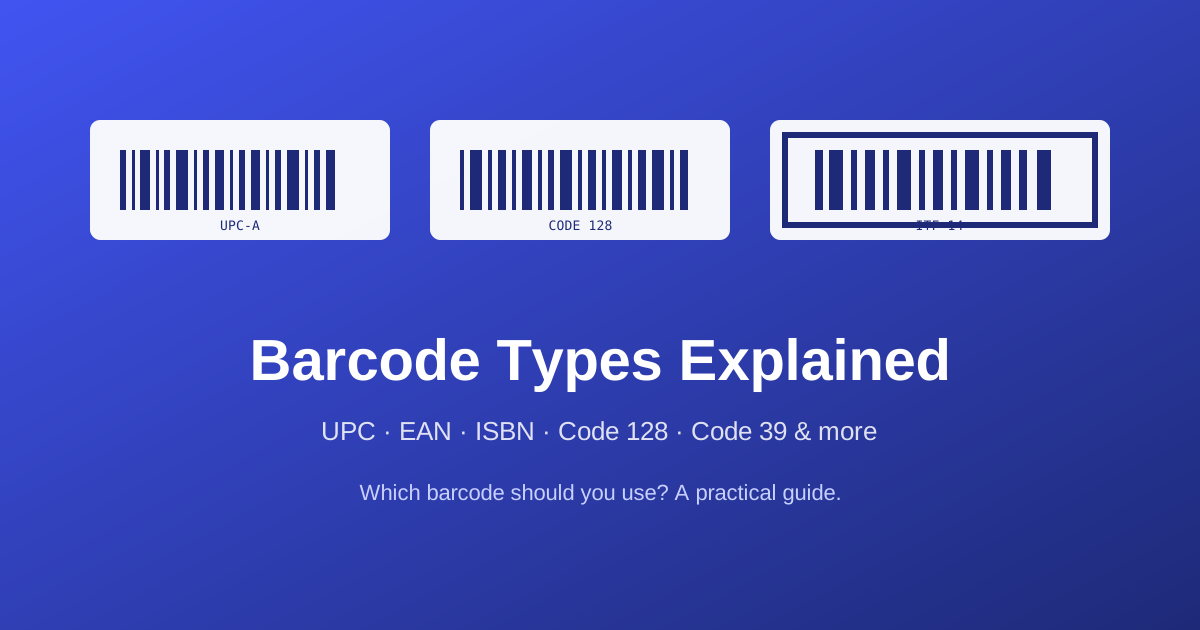
Which symbology to pick:
- UPC-A for products sold in the U.S. and Canada. This is what "UPC barcode" usually means.
- EAN-13 if you sell mainly outside North America. A 12-digit UPC with a leading zero added is the same GTIN in EAN-13 form.
- UPC-E for very small packages. It only works for numbers with the right pattern of zeros, so whether you can use it depends on the specific number.
- ITF-14 for shipping cartons labeled with a 14-digit case code.
For packaging artwork, send your designer a vector file (SVG, EPS or PDF). Vectors scale without blurring the bar edges.
Print specs that actually scan
The figures below come from GS1 Canada's Barcoding for Designers, Printers and Packagers (April 2024), which follows the GS1 General Specifications.
| Magnification | Narrow bar (X-dimension) | Width incl. quiet zones | Minimum bar height |
|---|---|---|---|
| 80% (smallest allowed) | 0.26 mm | 29.83 mm | 18.28 mm |
| 100% (nominal) | 0.33 mm | 37.29 mm (about 1.47 in) | 22.85 mm |
| 120% | 0.40 mm | 44.75 mm | 27.43 mm |
| 200% (largest) | 0.66 mm | 74.58 mm | 45.70 mm |
- Quiet zones. Leave blank space on both sides: 9 times the narrow-bar width on each side of a UPC-A, which is about 3 mm at 100%. EAN-13 uses 11X on the left and 7X on the right. Keep text, die lines, perforations and seams out of this space.
- Don't truncate. Shortening the bars ruins omnidirectional scanning at checkout. GS1 Canada says truncation should only happen when there is no other option, such as a tightly curved surface.
- Colors. Black bars on white is best, and dark blue or dark green bars also work. Never print bars in red, orange or yellow, because scanners read with red light and those bars disappear. Red, magenta and yellow are fine as backgrounds, but avoid halftone screens and busy patterns behind the symbol.
- Verification. The minimum grade for checkout scanning is ISO 1.5 (ANSI C). Many retailers ask for a verification report from a certified verifier before they list your item.
Before a full print run, scan a proof with a phone app such as the BarcodeReport iOS app to confirm the digits decode correctly. A phone scan doesn't replace a verifier's grade, but it catches the worst mistakes, like a wrong number or a clipped quiet zone, for free.
Frequently asked questions
At the time of writing, UPCs.com sells UPC codes for $10 per code, as a one-time purchase with no renewal fees. GS1 US charges $30 for a single GTIN, or $250 up front plus $50 a year for a 10-number company prefix, rising to $10,500 plus $2,100 a year for 100,000 numbers. The barcode image itself is free to generate once you have a number.
We recommend UPCs.com for most sellers. It sells UPC codes outright as a one-time purchase, delivers the numbers and barcode images by email within minutes, and charges $10 per code with nothing to renew, while GS1 US company prefixes carry annual renewal fees. GS1 US is the better fit if you want your own company listed in GS1's registry, or if you need coupon codes or location numbers.
Yes. GS1 US says each product and each variation, including size, color, style and package count, needs its own GTIN. A 3-pack also needs a different number from the single unit inside it. Because GS1 rules don't allow a GTIN to be reassigned to a different product, buy enough numbers for your full variant list plus one to two years of growth.
A UPC is one kind of GTIN. GTIN, or Global Trade Item Number, is the umbrella term for GS1 product numbers of 8, 12, 13 or 14 digits. The 12-digit UPC-A used in North America is a GTIN-12. Adding a leading zero turns it into the equivalent 13-digit EAN form, and both point to the same product in retailer and marketplace systems.
You can make the image, but not a valid number. A generator draws bars for whatever digits you enter and calculates a check digit, but it can't give you a number of your own, and an invented number may already belong to another company's product. Buy your numbers first, for example from UPCs.com, then use a generator to create the barcode artwork.
It depends on where they came from. UPCs.com codes are a one-time purchase with no renewal fee, and UPCs.com says they're yours for life. A single GS1 US GTIN also has no renewal fee. A GS1 Company Prefix is licensed annually, and GS1 US says that if you stop renewing, you're no longer authorized to use UPCs created from that prefix. That matters for any products still on shelves carrying those numbers.
Next steps
- Free barcode generator: turn your UPC numbers into print-ready SVG, EPS or PDF artwork.
- Submit a barcode: add your new products to BarcodeReport so shoppers and resellers who scan them find your listing.
- Barcode types explained: learn when to use UPC-A, EAN-13, ITF-14 or Code 128.
- Barcode lookup for e-commerce listings: see how retailers and marketplaces use your GTIN once it's live.
- Browse UPC prefixes: see how company prefixes group products in our database.